myTEMU
Introduction
Public hospital in Malaysia is one of the primary healthcare institutions in Malaysia. However, long waiting hour is one of the issues that are well aware of and demand attention. The proposal will explore a comprehensive approach to dealing with the issues by understanding the problem and tackling the issue accordingly using technology.
Timeline: 7 months (part-time basis)
Discipline
-
User Research, Interviews, and Analysis
-
Idea Generation
-
Rapid prototyping - Lo-fi
-
Iteration and Feedback Sessions
-
Usability Testing and Evaluation
-
Hi-fi prototyping
Team: Individual
Initial problem statement
What are the causes of long waiting hour in a government hospital?
How to solve it?
01
UX Roadmap
Understanding issue
Solutioning
Empathise
Define
Ideate
Prototype
Test
-
Whitepaper research
-
User research
-
Competitive analysis
-
User persona
-
User journey
-
Card sorting
-
Information architecture
-
Wireframe
-
Branding
-
Low-fidelity
-
Branding
-
Low-fidelity
02
White paper research
Healthcare in Malaysia
Healthcare services in Malaysia are divided into 3 types of ownership which are public hospitals, privately owned hospitals and non-profit private hospitals (Yorulmaz and Mohamed, 2019). The public sector provides a comprehensive range of services at an affordable cost while the private health sector provides health services concentrated in urban areas with special treatment.
In Malaysia, 65% of patients are registered with public sector hospitals. In term of services fee, public sector hospital fee is low as the government grant huge subsidy to the service (Khan and Qureshi, 2020). Further explained, while there is a high demand for public healthcare in Malaysia, the MOH is dealing with a high influx of patients, leading to low patient satisfaction and a perception of low-quality services. In order to get healthcare service at minimal cost, patients need to tolerate the long waiting hour (Khan and Qureshi, 2020). This issue has been addressed in the 12th Malaysian Plan 2021-2025 and a few approaches have been laid out to tackle the problems.
Technology in medical management
Besides that, medical advancement and technology growth in this century are one of the best revolutions for human civilization, to ensure health care is one of the basic responsibilities of every society (Khan and Qureshi, 2020). Digitalization makes it easier to find service quality and human error is very much limited due to the involvement of technology (Khan and Qureshi, 2020).
Long waiting hour issue
.png)
Issues
Category of patients that experience a long waiting hour
Scenario
Approaches
Reflection
How to design an app that can help to reduce waiting time in a holistic way? What is the user perception of the suggestion provided by MOH?
03
User Research
I personally understand the issue of long waiting hours as I experienced it myself a few times. Thus, in order to validate my experience with other potential users, I conducted a survey and interview.
Survey
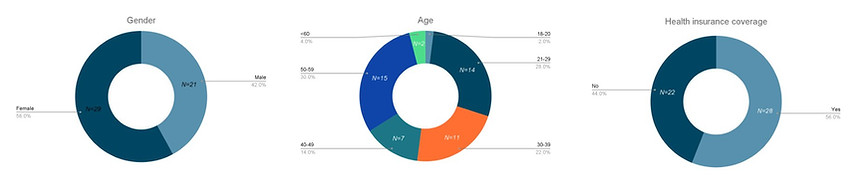
Firstly, a survey was conducted online via Google Forms on December 2022. It received 50 respondents within 4 days. The respondent's age is between 18 years old and above. The parameter is the selection of healthcare services based on the medical situation with the reasoning behind it.
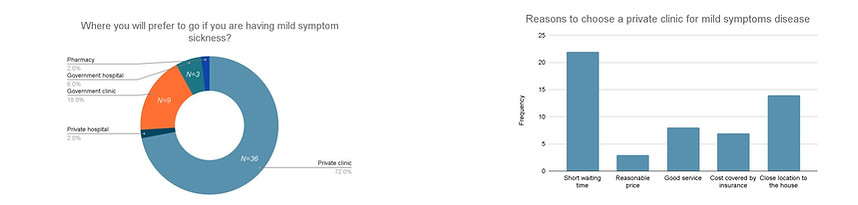
Preference of health institution for mild symptoms of sickness
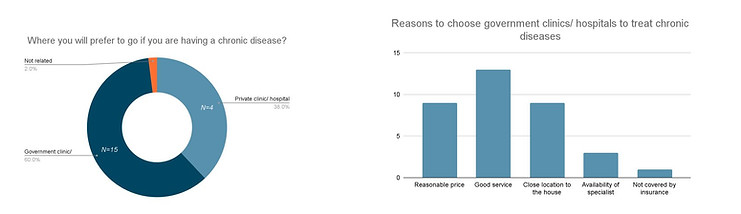
Preference of health institution for chronic diseases
72% of the respondent prefers to go to private clinics when having mild symptoms. The result reflects that waiting time is crucial for selecting health institutions to seek doctor consultations. The rest of the respondents who choose to go to the government clinic/ hospital are going there mainly due to the reasonable price offered.
60% of the respondent preferred to go to a government clinic/ hospital to get treatment for chronic diseases that require follow-up by a doctor due to good service, reasonable price and close location to the house. Those who choose to go to private clinics/hospitals mainly choose to go there due to the availability of health insurance. Although 56% of the overall respondent are covered by insurance, there is still a high demand in government clinics/ hospitals for chronic disease treatment that require follow-up treatment.
Insight
Most people are willing to spend some money in getting quick treatment in the private healthcare system. On the other hand, for a long-term disease that requires long-term treatment, most of the respondent prefers to go to public healthcare due to the robust services and affordability in term of cost.
These finding proved that there is a demand for public healthcare.
Interview
A semi-structured interview has been conducted with 4 interviewees that have experience as a patient in a government hospital/ clinic to gather their perspective on the current public healthcare services. The questions are related to the:
-
the perspective of the long waiting time issue
-
perception of MOH approaches - digital appointment system, virtual consultation, online medication system and digital medical history
1# Long waiting time in relation to the appointment system
-
Most of the users are aware of the issue of long waiting hours. ¾ of them tolerating with the issue due to minimal treatment cost and satisfying services by the hospital’s staff. They also understand that the issue is also related to the shortage of staff
-
There are efforts by the government to digitalise the appointment system in clinics but the system is not centralised and not applicable throughout Malaysian clinics.
-
Suggestion to centralise the appointment system to one platform.
-
2# Potential in a virtual consultation
-
Virtual consultation for the doctor
-
face-to-face consultation is more efficient compared to virtual consultation. It can be an option for a specific case that does not require a major physical examination
-
-
The virtual consultation with a pharmacist - can be explored when the patient may forget about the medication consumption when they are away from the hospital/ clinic
3# Demand to digitalise medication prescription and track record
-
Digitalising the physical medication slip helps to reduce the risk missing of the medication slip besides assists a patient to monitor their medication intake
-
Propose to integrate more features will be a digital medical record with the appointment date, medication record, reminder on appointment and medication intake, menstrual cycle calendar, etc)
-
Introduce to the patient the current procedure to restock medication (ie: MyUbat apps) that eases the patient, ie: drive through etc
-
Suggest having a medication record on the phone to ease the referencing if they are visiting a private clinic and can track medication consumption
4# Awareness and knowledge about medicine
-
The patients are aware of the importance to know about the function of medicine which is informed by the doctor & pharmacist but if they would like to get to know more about their medication, they find the source out there is not reliable and difficult to find a reliable source of information as their medication dosage is very specific.
-
Currently, the knowledge platform about health is available on MOH websites and their media social. So, propose to allow centralised digital access to information about health that is monitored by MOH with the apps.
-
Insight
Pain points for users are long waiting hours and the risk of missing medication slip
While most of the users are tolerating the long waiting hour issue, they are optimised towards the digitalisation of healthcare services.
What can we do to assist with this?
04
User Persona
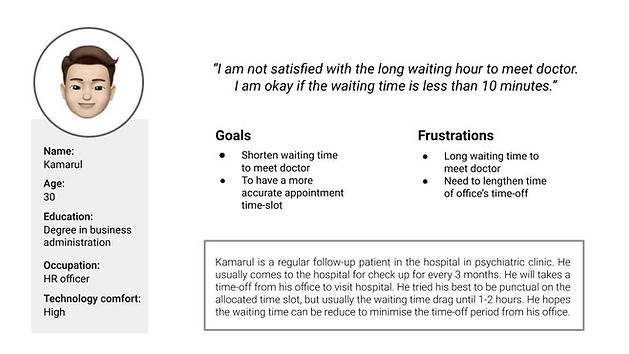
Kamarul represents the working class who needs treatment in the hospital but has time restrictions due to working conditions.

Aunt Hani represents the elderly who regularly has medication check-up in the hospital and hopes the number of visits to the clinic can be reduced.
05
User journey

Kamarul is a working-class persona that needs medical treatment from the hospital but has a restricted working schedule.
06
Competitive analysis
In the Malaysian context, MySejahtera and MyUbat have become the main reference for the government’s apps in this analysis. MySejahtera has centralised the digital appointment with digital health record while MyUbat has successfully digitalises the process of medication supply restocking for patients which indirectly reduce overcrowding at the clinic/ hospital. There is potential in combining the features of these apps to reduce waiting time.


HealthHub SG is a digital national health platform for Singapore’s government. WebMD is an app that helps to show symptoms of the disease. It also has a platform to set appointments with doctors. These 2 platforms are the most relevant reference for the study.


07
Card sorting
Based on the categories, the participants find out where the new information is the best place within existing features in MySJ. It is conducted by ranking the features based on the criteria which are very important, somewhat important, and less important.
Below is the tabulation of data based on the card sorting.
Very important
Important
Less important
Appointment
-
New
-
List
-
Reschedule
-
Reminder
Medicine
-
Restock
-
Digital medicine slip
-
Pharmacist consultation (not applicable for all)
Virtual consultation with doctor
Article
-
Healthcare
-
Medication
08
Information architecture
Based on card sorting, an information architecture diagram was created. Some of the features are re-organised for user wayfinding.
.png)
Insight
Based on the data, I've developed a low-fi wireframe of the proposal.
After that, I have conducted a usability testing to gain input on design improvements.
09
Low-fi wireframe
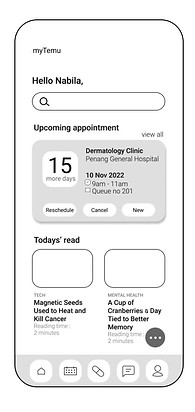
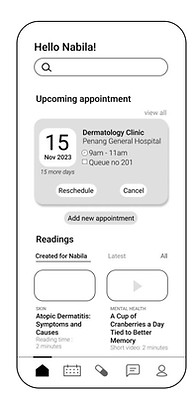
Based on feedback from 5 peers, I continue to adjust the design accordingly with these major improvements
#1
Adjust the hierarchy of information in the upcoming appointment area
-
To adjust the date to be the biggest to highlight the date
-
Move the ‘new’ appointment button to below the box to avoid confusion. This new button will allow patients to block new appointments for various cases
#2
To integrate appointments from the pharmacy into the calendar
-
Add medication restock appointments in the ‘my calender’ portal
-
To add names of doctors from past appointments for ease of future reference


#3
-
Customise topics for the knowledge feed
-
Introduce 2 kinds of reading materials
-
personalise topics for reading material based on personal disease/ interest
-
Latest information on healthcare, ie: the current spreading of disease
-
-
To design material that will increase the readability of the user
-
Short article, short video, infographic
-
10
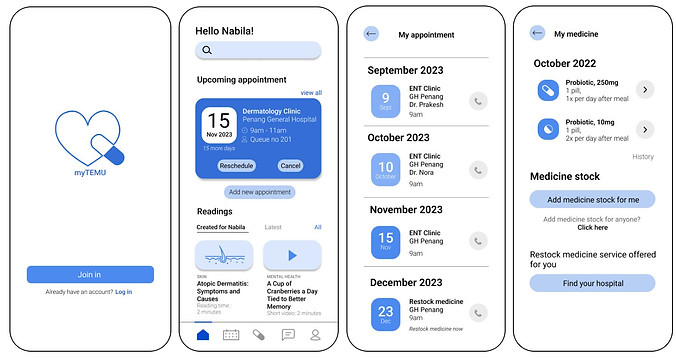
Final product